How to Read a Cooling Fan Label and Model Number Before Ordering a Replacement
Your old fan's label holds everything needed to order the right replacement. How to read each field and avoid the common mistakes.
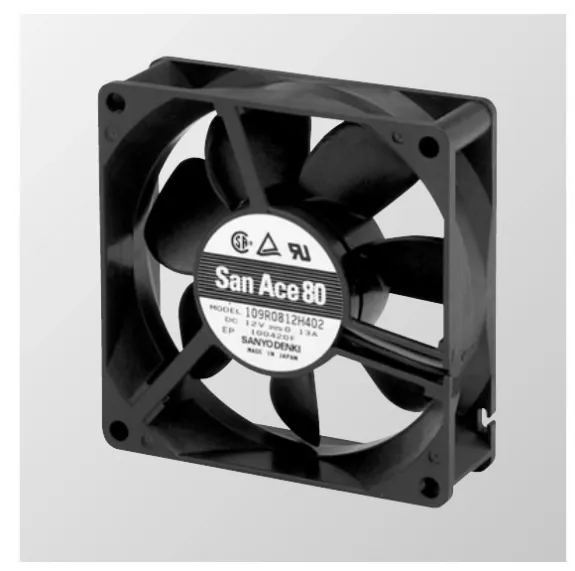
Before you remove a failed fan, photograph its label. The label holds everything needed to order the right replacement — size, voltage, model number and more — and it is the easiest thing to lose: once the fan is out and the label is scratched or thrown away, ordering becomes guesswork.
This guide explains what each field on a typical cooling-fan label means, how to read a model number without misreading it, and the mistakes that cause the most wrong orders.
What should I photograph before removing the fan?
Do this before unscrewing anything. Take one photo of the whole label, straight on and in focus, and a second close-up if any line is small or worn. Also photograph the fan from the side, so the thickness is visible, and note which way the air flows — the label is usually on the outlet side, and most labels carry a small arrow showing airflow direction and rotation.
Keep the old fan until the replacement arrives. If the label turns out to be unreadable, the fan itself can still be measured, and its connector and lead wires can be compared directly with the replacement.
What is on the label?
A typical DC cooling-fan label carries some or all of the following fields. Not every fan shows every field — a compact fan may show only the model number, voltage and current — but the model number itself is the key that unlocks the rest through the datasheet.
| Label field | What it tells you | Why it matters for a replacement |
|---|---|---|
| Manufacturer / brand | Who made the fan | Confirms the source series and the datasheet to look up |
| Model / part number | The exact fan, including its variant | The single most important field — see the next section |
| Rated voltage | e.g. DC 12 V or DC 24 V | The replacement must match; the wrong voltage will not run correctly |
| Rated current | The current the fan draws at rated voltage | Used to check the power supply and the replacement's load |
| Speed | Revolutions per minute at rated voltage | Affects airflow, pressure and noise together |
| Airflow and static pressure | Sometimes printed; often only on the datasheet | Must match the system's cooling need, not just the size |
| Bearing type | Ball or sleeve, where shown | Decides life, mounting position and temperature tolerance |
| Lead wires / connector | Number of wires and plug type | A replacement with the wrong plug needs rewiring |
| Date or lot code | When and where the fan was made | Helps trace the production batch if a defect is suspected |
| Certification marks | Such as UL, CE or RoHS, where applicable | Confirms the fan meets the equipment's compliance needs |
If a field is missing from the label, it is not missing from the fan: the model number leads to the datasheet, and the datasheet carries the full specification. That is why the model number matters more than any single printed value.
How do I read a model number?
A cooling-fan model number is a code, not a description. Its segments usually identify the series, the frame size, the voltage, and a variant — speed grade, bearing type, sensor function or lead-wire type. But the code is brand-specific: the same letters can mean different things for different manufacturers, and even for different series from the same manufacturer. There is no universal decoding table, and guessing from a similar-looking number is how wrong fans get ordered.
Read the model number with three rules. First, copy it exactly — every letter, digit and hyphen, including the suffix. A single changed letter at the end can mean a different speed, a different sensor, or a different connector, while the fan looks identical. Second, treat the suffix as part of the model, not as packaging information: it often carries the difference between a fan with a speed signal and one without, or between a ball bearing and a sleeve bearing version. Third, never decode it by analogy. If you know what a suffix means on one brand's fans, do not assume it means the same thing on another brand's fans — check the datasheet for that exact model.
The datasheet is the final word. It confirms what each segment of the number means, and it lists the full specification — voltage range, current, speed, airflow, static pressure, noise, life, temperature range and signal functions — for that exact variant. Our replacement checklist lists all ten points a replacement must match, and the model number is how you check each of them against the original rather than against a look-alike.
What mistakes cause the most wrong orders?
The most common mistake is ordering by size alone. Two fans can share the same frame size and still differ in thickness, voltage, speed, airflow and bearing type. A fan that fits the mounting holes but is thinner than the original may move too little air; a fan of the same size at the wrong voltage will not run as intended. Our size guide explains the size bands and the thickness trade-off — size is the starting point, not the whole order.
The second mistake is dropping the suffix. Ordering the base number without its trailing letters is ordering a different fan. It may arrive, fit perfectly, and still run at the wrong speed, lack the speed signal the equipment expects, or use a different bearing with a shorter life. If the supplier's listing shows a shorter number than your label, ask which variant it is before ordering.
The third mistake is matching the label's headline values but ignoring the ones that are only on the datasheet. Noise, life and static pressure are rarely all printed on the label, yet they decide whether the replacement is accepted: a fan that cools well but is much louder than the original will be rejected, and a fan with too little static pressure will not push air through a filter or a dense heatsink. Our noise guide explains how to compare dB(A) figures fairly, our bearing guide covers life and mounting, and the airflow vs static pressure guide explains why airflow alone is not enough.
The fourth mistake is assuming the replacement must be the same brand. Often it must — when the equipment's approvals or the customer's specification name a brand. But in many repairs, a different brand's fan with the same size, voltage, airflow, pressure, noise, bearing type and connector will work. The label tells you what to match; whether the brand itself must match is a question for the equipment's specification, not for the label alone.
Finally, check the airflow direction and the connector before ordering. A fan that blows the wrong way cools nothing, however perfect its numbers are, and a fan with the wrong plug cannot simply be forced onto the equipment's socket. Compare the lead-wire count and the plug with the original: two wires means power only, three usually adds a speed signal, and four usually adds speed control as well — but the exact functions must be confirmed on the datasheet, not assumed from the wire count.
What if the label is unreadable?
Labels fade, especially on fans that have run hot for years. If the model number cannot be read, do not guess. Measure the frame size and thickness, note the rated voltage from the equipment's power supply or wiring, count the lead wires, photograph the connector, and record the mounting and airflow direction. With those details a supplier can usually narrow the match to a small number of candidates, and the equipment's manual or parts list may name the original fan even when its label is gone.
A fan that has been replaced before can also mislead: the label on the fan in the equipment now may not be the label on the fan the equipment shipped with. If the current fan looks like a substitute — different brand, hand-written markings, or a number that does not appear in any catalogue — check the equipment manual as well as the label before ordering its copy.
What is the five-minute ordering checklist?
Work through the label in this order, and write each answer down before searching for a replacement. One, the full model number, copied exactly with its suffix. Two, the frame size and thickness, measured if the label does not state them. Three, the rated voltage and current. Four, the bearing type and the signal or lead-wire type, from the label or the datasheet. Five, the airflow direction, rotation arrow and connector type, from the label and a photo of the fan in place.
Then check the replacement against the original on the datasheet — not on the listing headline alone — for size, voltage, airflow, static pressure, noise, life and signals. A replacement that matches on all of those is the right fan, even if it looks identical to three wrong ones.
How do I order the right fan?
Start from the original fan: photograph the label before removing it, copy the full model number exactly, and note the size, voltage and connector. Then check the replacement against the original on the datasheet, not just on size and voltage.
That is how we match replacement fans at Xuanrui. Send us the original model number — or a photo of the fan label — and we will check the candidate against the original fan's datasheet across our NMB, AVC and SANYO fan ranges, including the bearing type, speed grade and signal functions the label points to. Or contact us with the original model number and a photo of the label, and we will check the replacement for you.
Common questions
Is the size on the label enough to order a replacement?
No. Two fans can share the same frame size and still differ in thickness, voltage, speed, airflow and bearing type. A fan that fits the mounting holes but is thinner than the original may move too little air, and a fan of the same size at the wrong voltage will not run as intended.
Does the suffix of the model number really matter?
Yes — it is part of the model, not packaging information. A single changed letter at the end can mean a different speed, a different sensor or a different connector, while the fan looks identical. Always copy the full number exactly, suffix included.
What if only part of the model number is readable?
Do not guess the rest. Measure the frame size and thickness, note the rated voltage from the equipment's power supply, count the lead wires, photograph the connector and record the airflow direction. With those details a supplier can usually narrow the match to a few candidates, and the equipment's manual or parts list may name the original fan.
Can I use a different brand as a replacement?
Often yes — if the size, voltage, airflow, static pressure, noise, bearing type and connector all match the original. But when the equipment's approvals or the customer's specification name a brand, the brand itself must match too. That is a question for the equipment's specification, not for the label alone.
How do I tell which way the fan blows?
The label is usually on the outlet side, and most labels carry a small arrow showing airflow direction and rotation. Photograph the fan in place before removing it, and note the arrow — a fan that blows the wrong way cools nothing, however perfect its numbers are.