Ball Bearing vs Sleeve Bearing Cooling Fans: Life, Mounting and Temperature
Ball bearing or sleeve bearing? How the two fan bearing types differ in life, temperature, mounting and noise — and which to choose for a replacement.
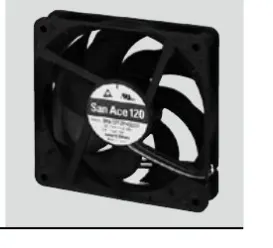
Ball bearing and sleeve bearing are the two bearing types in most small DC cooling fans. The bearing decides how long a fan lasts, how hot it can run, how it can be mounted, and how it sounds as it ages — so matching the original bearing matters as much as matching size and voltage.
Most small DC cooling fans use one of the two. Neither is better in every situation — choosing the wrong one is a common reason a replacement fan fails early, even though its airflow and voltage matched the original perfectly.
How do the two bearing types work?
A ball bearing fan uses small steel balls rolling between two rings to support the shaft. Rolling contact has low friction, and the bearing is sealed with a small amount of grease. The rotor stays centred even when the fan is mounted at an angle, and the bearing keeps working in much the same way as it wears.
A sleeve bearing fan uses a shaft turning inside a sleeve lined with a porous, oil-impregnated material. The shaft rides on a thin film of oil rather than on rolling balls. It is a simpler construction with fewer parts, which is why sleeve bearing fans usually cost less.
That construction difference explains almost everything that follows: life, temperature behaviour, mounting position and noise.
Which bearing lasts longer?
As a rule, a ball bearing fan lasts longer than a sleeve bearing fan of the same size and speed. The rolling bearing loses its lubricant slowly, and its wear is gradual. A sleeve bearing depends on its oil film: as the oil is gradually lost or thickens with age, friction rises, the fan runs louder, and eventually the shaft can seize or the fan can stop starting reliably.
How much longer depends on the fan, its speed and its operating temperature, so this guide gives no hour figure for either type — check the rated life on the model's own datasheet, and compare fans at the same temperature, because a life figure quoted at a cool room temperature does not mean the same life in a hot cabinet. What matters for selection is the direction of the difference: where long, unattended service matters — equipment that runs around the clock, a cabinet that is hard to reach, or a device where a fan failure stops the whole machine — a ball bearing fan is usually the safer choice. Where the fan is easy to reach and cheap to replace, and the equipment is replaced every few years anyway, the shorter life of a sleeve bearing fan may never become a problem.
A worn bearing also announces itself. A fan that has grown noisy in service, or that sometimes needs a flick to start, is often a fan whose bearing is near the end of its life. If that fan is a sleeve bearing type running hot, replacement should not be put off: noise is a warning, not just an annoyance.
Which bearing handles heat better?
Temperature affects both types, but it hurts a sleeve bearing more. Heat thins and evaporates the oil film, so a sleeve bearing fan running continuously in a hot enclosure loses life faster than the same fan in a cool one. A ball bearing fan also ages faster when hot — its grease degrades — but it tolerates high temperatures better and its life falls off less steeply.
This is why the datasheet temperature range matters alongside the bearing type. A fan rated for a hot environment is not automatically suitable if its bearing is the wrong type for that heat, and a fan with the right bearing still fails early if it is run above its rated temperature. Read the two together: bearing type and temperature range, on the same datasheet. Our IP ratings guide (https://www.xrcoolingfan.com/posts/cooling-fan-ip-ratings-explained) covers a related point — protection against dust and water — which also matters in harsh environments, but protection and bearing life are separate checks.
Does mounting position matter for bearing life?
Mounting position is where sleeve bearing fans most often catch buyers out. A sleeve bearing relies on the oil film staying where the shaft needs it, and gravity works against that when the fan is mounted with its shaft horizontal — for example, blowing sideways, or mounted flat with the shaft pointing up or down in some orientations. In those positions a sleeve bearing can wear unevenly and fail earlier than it would mounted upright.
A ball bearing fan has no such restriction in practice: it can be mounted in any orientation — upright, sideways or flat — without a meaningful change in bearing life. That is one reason ball bearing fans are the default choice for equipment where the fan's mounting position is fixed by the cabinet, or where the same fan model is used in different positions across a product range.
Before ordering a replacement, check how the original fan is mounted. If it blows sideways or sits flat, and the original was a ball bearing fan, replacing it with a sleeve bearing fan of the same size and airflow is a downgrade in life, even if every number on the label matches. The replacement checklist (https://www.xrcoolingfan.com/posts/cooling-fan-replacement-why-size-is-not-enough) lists bearing type among the points size alone cannot settle — this is the point it is warning about.
Which bearing is quieter — and cheaper?
In one respect the sleeve bearing fan usually wins: noise. A sleeve bearing fan is often quieter than a ball bearing fan of the same size and speed, because there is no rolling contact. For quiet office equipment, home appliances or medical rooms, that can matter — especially when the fan runs at low speed, where the bearing sound is a larger share of what you hear. Our noise guide (https://www.xrcoolingfan.com/posts/cooling-fan-noise-explained) explains how to read the dB(A) figure and why speed matters more than bearing type for overall loudness; bearing type changes the character of the sound as much as its level.
Cost points the same way as noise. Sleeve bearing fans are usually cheaper, because the bearing is simpler to make. For a high-volume product where the fan is accessible and the equipment's own life is short, that saving is real. For a single replacement in an expensive machine, the price gap between the two bearing types is usually small compared with the cost of a second failure and a second service visit.
| Ball bearing | Sleeve bearing |
Typical life | Longer | Shorter |
High-temperature tolerance | Better | Weaker — oil film suffers first |
Mounting position | Any orientation | Best upright; horizontal or flat mounting shortens life |
Noise | Slightly louder rolling sound | Usually quieter |
Cost | Higher | Lower |
Best for | 24-hour operation, hot cabinets, hard-to-reach fans, any mounting angle | Quiet, cool, easily replaced fans in accessible equipment |
These are general tendencies, not guarantees for any particular model — a well-made sleeve bearing fan can outlast a poor ball bearing fan, and the datasheet for the exact model is always the final word.
How do I choose the right bearing for a replacement?
Work through the choice in this order. First, match the original fan's bearing type if you can: read the original label and datasheet, and if the original was a ball bearing fan, stay with ball bearing unless there is a good reason to change. Second, check the mounting position and the temperature inside the equipment — a hot cabinet or a sideways-mounted fan points to ball bearing. Third, weigh noise against life: if the equipment must be quiet and the fan is easy to replace, a sleeve bearing fan is a reasonable choice; if the fan must run for years without attention, choose life over quiet.
Then check the rest of the specification as usual — size and thickness, voltage, airflow and static pressure at the system's actual resistance. Bearing type does not change the airflow a fan produces, so the size guide (https://www.xrcoolingfan.com/posts/cooling-fan-sizes-explained) and the airflow vs static pressure guide (https://www.xrcoolingfan.com/posts/cooling-fan-airflow-vs-static-pressure) still apply unchanged. A fan with the right bearing but too little airflow against the system's resistance is still the wrong fan.
How do I order the right fan?
Start from the original fan: note its size and thickness, read the label for voltage and model number, and find its datasheet bearing type, rated life and temperature range. Then check the replacement against the original on bearing type, mounting position, life and temperature — not just size and voltage.
That is how we match replacement fans at Xuanrui. Send us the original model number — or a photo of the fan label — and we will check the candidate against the original fan's datasheet across our NMB, AVC and SANYO fan ranges (https://www.xrcoolingfan.com/brand-zone), including ball bearing options where long life or any-angle mounting is needed. Or contact us (https://www.xrcoolingfan.com/contact-us) with the original model number and how the fan is mounted, and we will check the replacement for you.
Common questions
How do I tell whether my old fan is ball bearing or sleeve bearing?
Check the original fan's datasheet or model number first — the bearing type is listed there, but rarely printed on the label itself. If you cannot find it, send us the model number or a photo of the label and we will check the datasheet for you.
Can I replace a ball bearing fan with a sleeve bearing fan?
Only if the fan is mounted upright, runs in a cool cabinet and is easy to reach and replace. Otherwise no — in a hot cabinet, a sideways mounting or a hard-to-reach spot, a sleeve bearing fan will fail much earlier than the ball bearing fan it replaces.
Which bearing is better for a fan mounted sideways?
Ball bearing. A sleeve bearing relies on its oil film staying in place, and gravity works against it when the shaft is horizontal, so it wears unevenly and fails earlier. A ball bearing fan can be mounted in any orientation without a meaningful change in bearing life.
Are sleeve bearing fans always quieter?
Usually, at the same size and speed, a sleeve bearing fan is quieter because there is no rolling contact. But speed matters more than bearing type for overall loudness — a fast sleeve bearing fan can still be louder than a slow ball bearing fan. See our noise guide (https://www.xrcoolingfan.com/posts/cooling-fan-noise-explained) for how to read the dB(A) figure.
Does a ball bearing fan last longer in a hot cabinet?
Yes, it tolerates heat better — its grease degrades more slowly than a sleeve bearing's oil film. But it is not immune to heat: always check the rated temperature range and the rated life on the exact model's datasheet, and compare life figures at the same temperature.