AC Cooling Fans vs DC Cooling Fans: Key Differences and When to Use Each
AC or DC? How mains-powered and low-voltage fans differ in wiring, speed control, noise and safety — and how to tell which type your equipment needs.
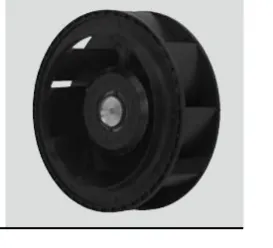
Two fans can look identical — same size, same shape, same mounting holes — and still be completely different parts. One runs straight from the mains supply; the other needs low-voltage DC. Fit the wrong type and the fan will not run at all, or it will be damaged the moment power is applied.
This guide explains how AC and DC cooling fans differ, where each type belongs, and how to tell which one your equipment needs before you order a replacement.
What is an AC fan?
An AC cooling fan runs directly on alternating current from the mains supply — typically 100 V, 115 V or 230 V AC, depending on the country and the equipment. It connects straight to the mains, with no separate power supply in between.
Inside, most AC fans use an induction-type motor, often a shaded-pole or capacitor-run design. The motor's speed is tied closely to the frequency of the mains supply — 50 Hz or 60 Hz — so an AC fan generally runs at one more or less fixed speed whenever it is switched on. It starts, runs, and stops with the equipment; there is no built-in way for the equipment to slow it down or speed it up.
That simplicity is why AC fans are still common. They are robust, they need no extra power supply, and they suit equipment that already has mains power inside the cabinet and needs steady, continuous cooling: industrial control cabinets, large power supplies, welding equipment, commercial refrigeration and similar machines. In those places the fan is simply on whenever the machine is on, and that is exactly what is wanted.
What is a DC fan?
A DC cooling fan runs on low-voltage direct current — most commonly 5 V, 12 V, 24 V or 48 V DC — supplied by the equipment's own power supply. It cannot be connected to the mains. Almost all modern DC fans are brushless: an electronic circuit inside the fan switches the motor coils in turn, instead of a mechanical commutator.
Because the speed of a DC fan depends on the voltage applied to it, and on the control signal where one is fitted, a DC fan can be slowed down and sped up. A 4-wire DC fan with a PWM input lets the system set the speed precisely; even a simple 2-wire DC fan can be slowed by lowering its supply voltage, within the range its datasheet allows. Our wire-signals guide explains the 2-wire, 3-wire and 4-wire types and what each extra wire does.
That controllability is why DC fans dominate modern electronics. Servers, telecom equipment, medical devices, inverters and test instruments all run on low-voltage DC rails already, so a DC fan plugs into the power the equipment already has — and the system can slow it down at idle, which cuts noise sharply, as our noise guide explains.
How do AC and DC fans compare?
| AC fan | DC fan |
|---|---|---|
Power supply | Mains AC, typically 100 / 115 / 230 V | Low-voltage DC, typically 5 / 12 / 24 / 48 V |
Needs a separate power supply? | No — connects to the mains directly | Yes — needs a DC supply from the equipment |
Speed | More or less fixed, tied to the mains frequency (50 / 60 Hz) | Variable — set by voltage, or by PWM on a 4-wire fan |
Speed control and monitoring | Generally none | FG speed signal and PWM control available on 3-wire and 4-wire types |
Typical size range | Often larger, commonly 80 mm and up | From very small (20–40 mm) up to large sizes |
Where it is used | Industrial cabinets, large power supplies, machines with mains inside | Servers, telecom, medical, electronics — anywhere a DC rail exists |
Safety note | Mains voltage — wiring must be done by a qualified person | Low voltage — safer to handle, but still check polarity |
How do I tell which type I have?
The label on the fan is the surest guide. It states the rated voltage and whether it is AC or DC — for example "230 V AC" or "24 V DC". If the label is worn or missing, look at the power the equipment supplies to the fan: a fan wired to the mains terminals is AC; a fan wired to a low-voltage connector on a circuit board is DC.
The size can be a hint, but it is not proof. Very small fans — 40 mm and below — are almost always DC, because an AC motor is hard to build that small. Large fans can be either type, so size alone never decides it. Our sizes guide covers what each size band is normally used for.
The number of wires is another hint, but again not proof. A 2-wire fan can be AC or DC. A 3-wire or 4-wire fan with a speed signal or a PWM wire is DC — AC fans do not carry FG or PWM signals. If you are unsure, the model number on the label, checked against the model's datasheet, settles it.
What mistakes cause the most wrong orders?
The most serious mistake is connecting a DC fan to the mains, or an AC fan to a low-voltage DC supply. A DC fan connected to mains voltage will be destroyed immediately, and it is a safety hazard. An AC fan connected to a 12 V or 24 V DC supply will not run at all. The two types are not interchangeable, and no adapter or rewiring changes that — the motor inside is built for one kind of power only.
The second mistake is ordering by size and airflow alone. An AC fan and a DC fan of the same size can have similar airflow figures, but they are different parts. Check the voltage type first, then the voltage value, and only then the airflow and static pressure — our airflow vs static pressure guide explains why both of those numbers matter, and our replacement checklist lists the other points to check before ordering.
The third mistake is forgetting the mains frequency with AC fans. An AC fan rated for 50 Hz will run at a different speed on a 60 Hz supply, and vice versa — the speed, airflow and noise all shift with the frequency. Many AC fans are rated for both 50 Hz and 60 Hz, with different figures for each, so check which frequency your supply is and read the matching line on the datasheet. A DC fan has no such issue, because its supply is DC.
The fourth mistake is expecting speed control from an AC fan. If the equipment needs to slow its fans down at low load — to cut noise or save power — an AC fan cannot do it. That job needs a DC fan with a PWM input, or a different cooling design altogether. Fitting an AC fan where the system expects to control speed leaves the fan running at full speed all the time.
Finally, do not forget the wiring and safety rules. AC fans carry mains voltage, so their wiring, insulation and earthing must meet the equipment's safety standard, and the work should be done by a qualified person. DC fans are low voltage, but polarity still matters: reversing the positive and negative leads can damage a DC fan, so check the wiring diagram before connecting.
How do I choose between AC and DC?
Work backwards from the power the equipment already provides. If the fan position is wired to the mains, you need an AC fan at the right mains voltage and frequency. If it is wired to a DC rail, you need a DC fan at that rail's voltage — 12 V and 24 V are the most common, but check the label rather than guessing.
Then ask whether the equipment controls or monitors its fans. If it does, you need a DC fan with the right signal wires. If it simply switches the fan on and off with the machine, an AC fan may be the simpler and tougher choice.
Then check the rest of the specification as usual: size, thickness, airflow, static pressure, noise and bearing type, against the original fan's datasheet. A replacement that matches on power type as well as on cooling numbers is the right fan. One that matches only on cooling will not even start — or will be damaged the moment it is switched on.
How do I order the right fan?
Start from the original fan: read its label for the voltage and the AC or DC marking, and note the mains frequency if it is an AC fan. Then check the replacement against the original on the datasheet, power type first, then voltage, then the cooling numbers.
That is how we match replacement fans at Xuanrui. Send us the original model number — or a photo of the fan label — and we will check the candidate against the original fan's datasheet across our NMB, AVC and SANYO fan ranges, including whether it is an AC or a DC type. Or contact us with the original model number and a photo of the label, and we will check the replacement for you.
Common questions
Q: Can I replace an AC fan with a DC fan?
A: No. The two types are not interchangeable — the motor inside is built for one kind of power only. A DC fan connected to mains voltage will be destroyed immediately and is a safety hazard; an AC fan connected to a 12 V or 24 V DC supply will not run at all.
Q: How do I tell AC from DC if the label is worn or missing?
A: Look at what powers the fan: a fan wired to the mains terminals is AC; a fan wired to a low-voltage connector on a circuit board is DC. A 3-wire or 4-wire fan with a speed signal or PWM wire is DC — AC fans do not carry FG or PWM signals. If you are still unsure, the model number checked against the datasheet settles it.
Q: Does the mains frequency matter for an AC fan?
A: Yes. An AC fan's speed is tied to the mains frequency, so a fan rated for 50 Hz runs at a different speed — with different airflow and noise — on a 60 Hz supply, and vice versa. Many AC fans are rated for both frequencies with different figures for each, so read the line that matches your supply.
Q: Can an AC fan be speed-controlled?
A: Generally no. An AC fan runs at one more or less fixed speed whenever it is switched on. If the equipment needs to slow its fans down at low load, that job needs a DC fan with a PWM input — see our wire-signals guide.
Q: Are DC fans always the better choice?
A: No. DC fans win where speed control, monitoring or very small sizes matter. But where mains power is already inside the cabinet and the fan simply needs to run whenever the machine runs, an AC fan is often the simpler and tougher choice — it needs no separate power supply.